Katana Bridge: How to Bridge to Katana (2026 Guide)

To use the Katana bridge, open the official Katana app at app.katana.network, click Bridge, choose the network and token you are sending, and confirm in your wallet. Your funds arrive on Katana, an Ethereum Layer-2 with chain ID 747474. The older standalone page at bridge.katana.network still loads, but Katana now shows a notice there saying the page is being deprecated and the native bridge lives inside the app. This guide was checked against the live app, Katana’s documentation and L2BEAT in October 2026.
Key takeaways
- The Katana bridge is now the Bridge tab inside the Katana app (app.katana.network). The old bridge.katana.network page is being retired.
- The in-app bridge accepts deposits from 18 networks, including Ethereum, Polygon, Arbitrum One, Base, OP Mainnet, BNB Smart Chain and Avalanche.
- USDC, USDT, USDS, ETH and WBTC bridged from Ethereum exist on Katana as Vault Bridge tokens (vbUSDC, vbUSDT, vbUSDS, vbETH, vbWBTC), each backed 1:1.
- Katana’s docs list separate routes for a few assets: LayerZero and Stargate for jitoSOL, Chainlink CCIP through Lombard for LBTC, and Relay for other tokens.
- Gas on Katana is paid in ETH. Always confirm the chain ID is 747474 before you approve anything.
What changed with the Katana bridge?
Earlier guides, including the first version of this one, sent readers to a standalone site at bridge.katana.network. That page now carries a banner that reads: “The Katana native bridge is now integrated directly into the Katana app. As we are deprecating this page, we encourage you to use the Katana app to bridge your assets.”

If you have the old address bookmarked, replace it with app.katana.network. The move also widened what the bridge can do. The old page handled a short list of assets from Ethereum. The in-app bridge lets you pick from many source networks and tokens in one window.
What do I need before bridging to Katana?
- An EVM wallet such as MetaMask or Rabby. Add the network first using the details in our Katana Network setup guide (chain ID 747474, RPC and explorer).
- The token you want to move, on one of the supported source networks.
- Enough of the source network’s gas token to pay for the transaction, plus a little ETH on Katana for gas once you arrive.
How do I bridge to Katana, step by step?
- Go to app.katana.network. Type the address yourself or use a bookmark. Do not follow links from direct messages.
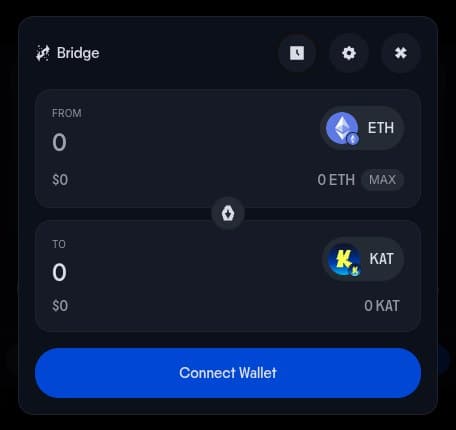
- Click Bridge in the top menu. A bridge window opens with a From box and a To box.
- Click Connect Wallet and approve the connection in your wallet.
- In the From box, open the token selector, choose the source network, then pick the token and enter an amount.
- In the To box, choose the token you want to hold on Katana. The window shows the amount you will receive.
- Review the numbers, approve the token if your wallet asks, then confirm the bridge transaction.
- Wait for the transfer to complete, then check your balance on Katana.
Send a small test amount the first time. Once it lands, repeat with the full amount.
Which networks can I bridge from?
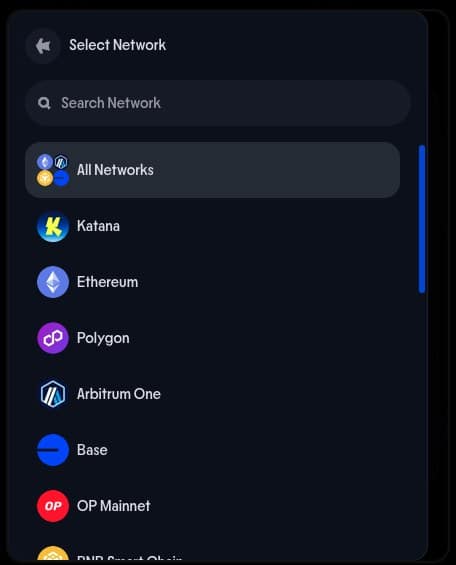
When we opened the network selector in October 2026, the Katana app listed 18 source networks besides Katana itself:
- Ethereum, Polygon, Arbitrum One, Base, OP Mainnet and BNB Smart Chain
- Avalanche, Arbitrum Nova, Gnosis and Etherlink
- Soneium, Sonic, Berachain, Monad, HyperEVM, Somnia, ApeChain and B3
The list can change, so treat the app as the source of truth. Coming from Polygon? Our Katana vs Polygon comparison explains how the two networks differ. Katana is not a Solana chain and you cannot send SOL to it directly. Our Is Katana on Solana? page explains the mix-up.
What are vbTokens and which assets become them?
Katana’s documentation says most tokens that are not native to Katana are canonically bridged from Ethereum mainnet. For five major assets, the canonical version on Katana is a Vault Bridge token, or vbToken. Each one is backed 1:1 by the asset you deposited.
| Asset on Ethereum | Token on Katana |
|---|---|
| USDC | vbUSDC |
| USDT | vbUSDT |
| USDS | vbUSDS |
| ETH / WETH | vbETH |
| WBTC | vbWBTC |
The deposited assets are put to work in vaults on Ethereum, and the yield is sent back to Katana as incentives. A vbToken sitting idle in your wallet does not compound by itself. To earn, you need to supply it to a lending market or liquidity pool. The full mechanism is in our VaultBridge and AUSD guide, and Katana’s Vault Bridge documentation is the primary source.
What other official bridge routes does Katana list?
Not every asset uses the canonical bridge. Katana’s bridging reference names these alternatives:
| Route | Used for | Notes |
|---|---|---|
| Canonical bridge from Ethereum | Most non-native tokens, including the vbTokens | Available in the Katana app |
| LayerZero via Stargate | jitoSOL, and USDC into vbUSDC through the OVault Composer | Docs quote about 3 to 7 minutes end to end |
| Chainlink CCIP via Lombard | LBTC | Bridged through Lombard |
| Relay | Other tokens with Sushi liquidity on Katana | Liquidity-based, so large amounts can move the price |
How long does bridging take and what does it cost?
Katana does not publish a fee schedule for the bridge, so we will not quote one. What you pay comes from three places:
- Source network gas. Usually the largest cost when you start from Ethereum mainnet, and it rises when the network is busy.
- Route cost. When you swap into a different token on the way, the price you get depends on available liquidity. Compare the receive amount in the To box with what you are sending.
- Katana gas. Paid in ETH for anything you do after arriving.
For timing, the only figure in Katana’s docs is for the LayerZero route: about 3 to 7 minutes in total, made up of 1 to 2 minutes for validators and 2 to 5 minutes for delivery. Other routes vary with the source network.
How do I bridge from Katana back to Ethereum?
Use the same Bridge window in the Katana app and set Katana as the From network. Withdrawals through the canonical bridge are slower than deposits. According to L2BEAT, a withdrawal message becomes available on Ethereum once the Katana block that contains it has been settled, and settling requires a ZK proof. No fixed time is published, so do not plan around an exact number. Keep some ETH on Ethereum mainnet in case the final step needs a transaction there.
Is the Katana bridge safe?
Katana combines an OP Stack base with Agglayer’s shared bridge and validity proofs. L2BEAT currently classifies it as a Stage 0 ZK rollup and notes that the Security Council can upgrade the system without a delay, which means users do not get an exit window before an upgrade. That is common for young Layer-2 networks, but it is a real trust assumption and worth knowing before you move large sums.
The more likely risk is a fake site. Protect yourself with a few habits:
- Bridge only from app.katana.network.
- Check the chain ID is 747474 in your wallet before approving.
- Never type a seed phrase into a website. A bridge only needs a signature.
- Test with a small amount first.
Common mistakes to avoid
- Using the old bridge.katana.network bookmark instead of the Katana app.
- Arriving on Katana with no ETH for gas.
- Leaving vbTokens idle and expecting them to earn yield.
- Assuming a withdrawal to Ethereum is as fast as a deposit.
- Ignoring the receive amount when swapping tokens during a bridge.
New to the chain? Start with What is Katana? Ready to put bridged assets to work? See the Katana staking guide. If you want the token itself, read how to buy KAT.
Frequently asked questions
What is the official Katana bridge?
The official Katana bridge is the Bridge tab inside the Katana app at app.katana.network. The older standalone page at bridge.katana.network is being deprecated.
Which networks can I bridge to Katana from?
In October 2026 the Katana app listed 18 source networks, including Ethereum, Polygon, Arbitrum One, Base, OP Mainnet, BNB Smart Chain and Avalanche.
What tokens do I get when I bridge to Katana?
USDC, USDT, USDS, ETH and WBTC bridged from Ethereum become vbUSDC, vbUSDT, vbUSDS, vbETH and vbWBTC on Katana, each backed 1:1 by the deposited asset.
How long does the Katana bridge take?
Katana’s docs quote about 3 to 7 minutes for the LayerZero route. Other routes vary by source network, and withdrawals to Ethereum wait for the block to be settled with a ZK proof.
Do vbTokens earn yield automatically?
No. An idle vbToken in your wallet does not compound. Supply it to a lending market or liquidity pool on Katana to earn.
Can I bridge from Solana to Katana?
Not directly. Katana is an Ethereum Layer-2, not a Solana chain. Katana’s docs list jitoSOL as bridged through LayerZero and Stargate.
