
Dogwifhat (WIF) Price Prediction and Investment Outlook

When you look at the crypto market today, it is easy to dismiss assets like Dogwifhat as mere speculation or fleeting internet humor. But, experienced investors know that dismissing liquidity and volume based on a name is a mistake. WIF has established itself as a dominant force within the Solana ecosystem, acting as a high-beta proxy for the network itself. If you are managing a high-risk portfolio, you simply cannot ignore the sheer capital rotation that moves through this asset during market expansions. In my years analyzing digital assets, I have rarely seen a meme token capture institutional attention as quickly as WIF did, transitioning from an on-chain joke to a multi-billion dollar asset class in record time.
Your interest in a dogwifhat price prediction likely stems from a desire to gauge whether the upside potential still outweighs the downside risk. You want to know if we are looking at a cycle top or if this asset has the staying power of something like Dogecoin. Understanding where WIF is headed requires us to strip away the meme narrative and look strictly at the data: volume profiles, wallet retention, and the broader macro environment affecting risk-on assets. This analysis focuses on the hard numbers and market psychology driving the price, giving you a clear picture of what the next few years might hold for your investment.
Key Takeaways
- WIF has established itself as a blue-chip meme coin on Solana, acting as a high-beta proxy for the network’s success.
- A realistic short-term dogwifhat price prediction suggests a market correction in early 2026 followed by stabilization around the $2–$3 support levels.
- Technical analysis indicates that decreasing volume during price dips signals seller exhaustion and potential future demand.
- Long-term forecasts for 2030 imply that WIF could reach double-digit valuations if it matures into a legacy asset similar to Dogecoin.
- Investors should closely monitor Solana’s network performance and social sentiment metrics, as these are the primary fundamental drivers of WIF’s value.
The Latest Market Dynamics and Technical Analysis
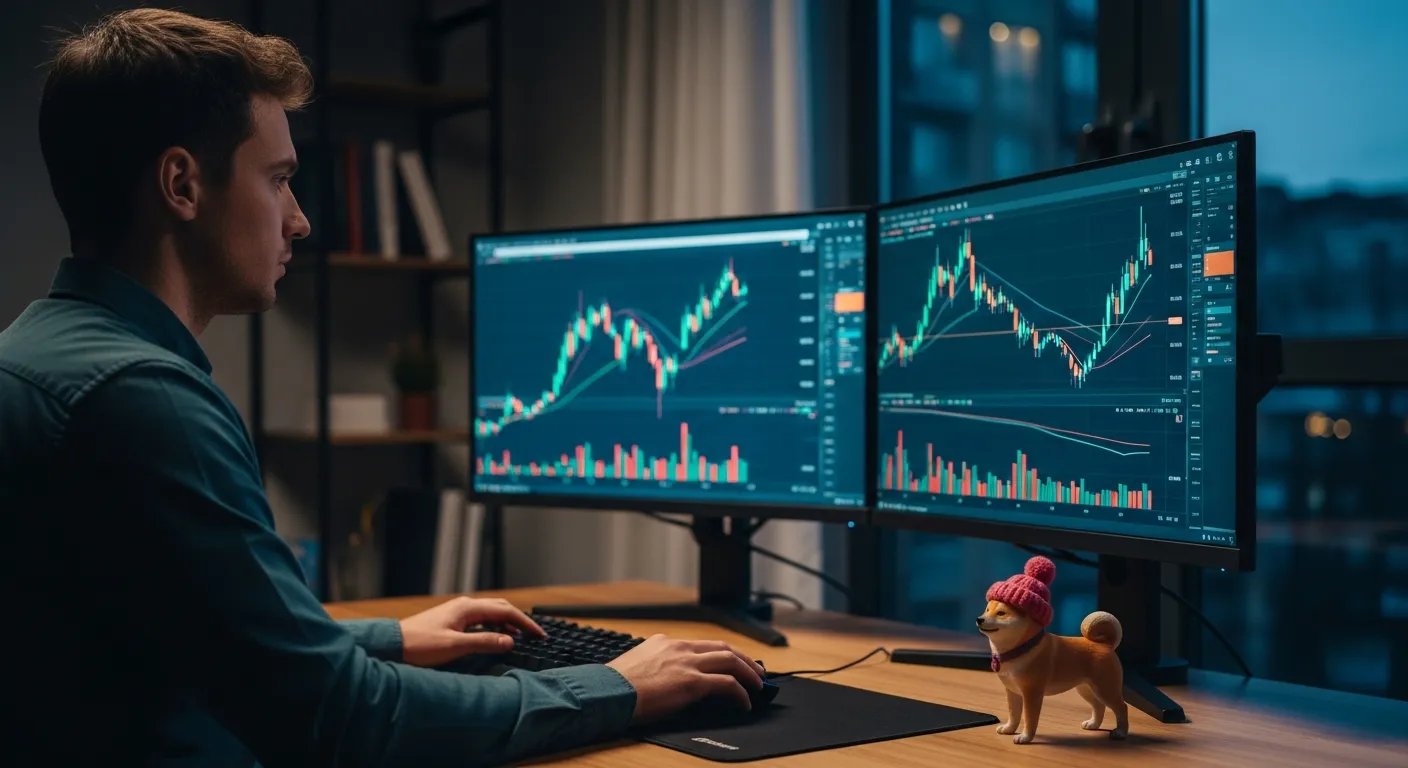
To understand where the price is going, you first have to understand the ground you are standing on right now. The current market structure for WIF suggests a period of consolidation after its initial explosive discovery phase. When you look at the daily and weekly charts, you will notice that the volatility has started to compress. In technical analysis, this compression often precedes a significant move. The asset is currently respecting key moving averages, which indicates that while the speculative frenzy has cooled, there is sustained demand keeping the price from collapsing. This is a sign of maturity in the asset’s lifecycle that many lesser meme coins never achieve.
Volume analysis paints an interesting picture as well. In my experience, a drop in volume during a price correction is usually bullish because it suggests that sellers are exhausted. We are seeing exactly that with WIF right now. The aggressive selling pressure that typically follows a massive rally has dissipated, leaving behind a group of holders who are seemingly waiting for the next catalyst. You should also pay attention to the correlation between WIF and Solana. For a long time, WIF moved almost in lockstep with SOL, but recently, we have seen moments of decoupling where WIF shows independent strength. This divergence is critical because it implies that the token is developing its own market identity, separate from the performance of its parent chain.
Short-Term Forecast: 2026 Quarterly Projections
Looking ahead to 2026, the market conditions will likely be shaped by the aftermath of the expected 2025 bull cycle peak. If history repeats itself, early 2026 could be a time of correction or stabilization for the broader crypto market. For high-volatility assets like WIF, this period will be a stress test. You need to be prepared for wider price swings as capital rotates out of riskier plays and back into stablecoins or Bitcoin. But, because WIF has established itself as a blue-chip meme coin on Solana, it may absorb liquidity better than smaller cap competitors.
Q1 and Q2 2026 Expectations
In the first quarter of 2026, I anticipate WIF might trade in a reactionary range. If the market overheats in late 2025, Q1 2026 will likely involve a cooling-off period. You might see prices retracting from their all-time highs as profit-taking dominates the narrative. A realistic target range during this correction phase could be anywhere from thirty to forty percent below its 2025 peak. By the second quarter, but, markets tend to find an equilibrium. Historically, this is when smart money begins re-accumulating. If the Solana ecosystem remains robust, WIF could see a stabilization phase in Q2, trading sideways as it builds a base for the next leg up. You should watch for lower volatility and steady accumulation patterns during these months.
Critical Support and Resistance Levels
Identifying where to enter or exit is more important than guessing the exact top. Based on current volume profiles, there are specific price levels that will likely act as major battlegrounds. On the downside, the two-dollar and three-dollar marks have historically acted as strong psychological barriers. If the price pulls back, you can expect significant buy orders to sit at these levels. On the upside, previous all-time highs will serve as stiff resistance. Breaking through these levels in 2026 will require fresh liquidity entering the crypto market. You should mark these zones on your chart now, as they will likely dictate the trend for the majority of the year. If support at the lower levels breaks, it could signal a deeper bear market, but holding these levels would confirm WIF’s status as a long-term survivor.
Long-Term Price Trajectory: 2027 to 2030
Forecasting prices several years out is always an exercise in probability rather than certainty, but long-term trends offer us clues. By 2027, the crypto market will likely be in the accumulation phase of the next four-year cycle. For you as an investor, this is often the most difficult time to hold because the excitement is low, and the price action is slow. But, this is also where generational wealth is often made. If WIF maintains its position as the leading meme coin on Solana, its valuation in 2027 and 2028 could see a steady, grinding increase rather than vertical spikes.
Estimated Growth for 2027-2028
During these years, the growth of WIF will likely depend less on hype and more on the expansion of the Solana user base. I expect to see WIF trading at multiples higher than its 2024 lows, potentially establishing a floor price that is significantly above current levels. A conservative estimate sees the asset benefiting from global liquidity injections that typically occur during these mid-cycle years. You might see the price consolidate in a higher range, acting as a store of value for meme-centric liquidity. The days of 100x returns overnight might be over by then, replaced by more sustainable, albeit slower, appreciation.
Decade-End Projections for 2030
By 2030, the crypto asset class will look very different. Regulation will likely be clear, and institutional participation will be the norm. If WIF survives until 2030, it will join the ranks of Dogecoin as a legacy meme asset. In this scenario, the price could reach valuations that seem improbable today, driven purely by scarcity and brand recognition. We could be looking at a market capitalization that rivals major traditional companies. But, you must also consider the survivorship bias. Most meme coins do not last a decade. If WIF is still around, it implies it has successfully transitioned from a trend to a cultural staple. In that case, a price target in the double digits is not out of the question, assuming the broader crypto market cap has expanded into the tens of trillions.
Fundamental Drivers Behind WIF Price Movements
While technicals tell you what is happening, fundamentals tell you why. You might think a dog with a hat has no fundamentals, but in the attention economy, community and network effects are the fundamentals. The primary driver for WIF is its symbiotic relationship with the Solana blockchain. When Solana succeeds, WIF succeeds. It has become the de facto mascot for the chain’s speed and low fees, attracting retail investors who cannot afford the gas fees on Ethereum. This accessibility is a fundamental strength that provides a constant stream of new buyers.
Influence of Solana Network Performance
You need to watch Solana’s metrics closely if you hold WIF. High transaction throughput and increasing daily active users on Solana act as direct catalysts for WIF’s price. I have found that WIF often outperforms SOL during bullish network updates because it moves with higher volatility. Essentially, traders use it as a leveraged bet on Solana’s success. If the Solana network faces outages or congestion issues, WIF is often the first to suffer a sell-off. Hence, your investment thesis for WIF should basically be a derivative of your thesis for Solana.
Market Sentiment and Institutional Interest
Sentiment is the engine of all meme coins, and measuring it requires looking at social dominance and engagement metrics. Recently, we have seen a shift where even traditional finance commentators acknowledge WIF. This institutional acknowledgement validates the asset. When hedge funds and proprietary trading desks start trading a meme coin to capture volatility, it creates a floor for liquidity. You are no longer just trading against retail speculators: you are trading in a market with deep pockets. This shift reduces the likelihood of the price going to zero and increases the stability of the asset over the long term.
Strategic Risks for Crypto Investors
No honest analysis is complete without a hard look at the risks. You are dealing with an asset class that can depreciate by fifty percent in a single week. The primary risk for you is volatility management. Unlike Bitcoin, which has a massive global infrastructure supporting its value, WIF relies heavily on social sentiment. If the community moves on to a new shiny object, liquidity can dry up fast. I have seen countless community tokens die a slow death simply because the narrative shifted. You must be vigilant about social metrics: a drop in engagement is often a leading indicator of a price drop.
Regulatory risk is another factor you cannot ignore. While regulators have mostly focused on utility tokens and exchanges, there is always a chance that broad-sweeping regulations could impact how meme coins are traded or listed on centralized exchanges. If major exchanges were forced to delist assets like WIF due to compliance issues, the price impact would be catastrophic. Besides, the overall macroeconomic environment dictates the flow of capital. In a high-interest-rate environment, speculative assets are the first to be sold. You need to size your position with the understanding that this is the venture capital portion of your portfolio, high potential reward, but with a very real possibility of total loss.
Conclusion
Navigating the market for Dogwifhat requires a balance of conviction and caution. You are looking at an asset that has defined the current cycle on Solana and has shown remarkable resilience compared to its peers. The price predictions for 2026 and beyond suggest that while the explosive early growth phase might be behind us, there is significant potential for WIF to mature into a legacy asset with substantial value. But, you must approach this investment with your eyes open to the risks of volatility and sentiment shifts.
The data suggests that WIF is more than just a passing trend, but it is not a set-it-and-forget-it play like a sovereign bond. You need to actively monitor the Solana ecosystem, keep a finger on the pulse of market sentiment, and be ready to take profits when the market becomes euphoric. If you can manage your risk and handle the swings, WIF offers one of the most compelling risk-reward profiles in the current market. Keep your position size reasonable, respect your stop-losses, and treat this as a serious component of your high-risk allocation.
