
Solana (SOL) Below $80 Risks Restarting A Brutal Downtrend
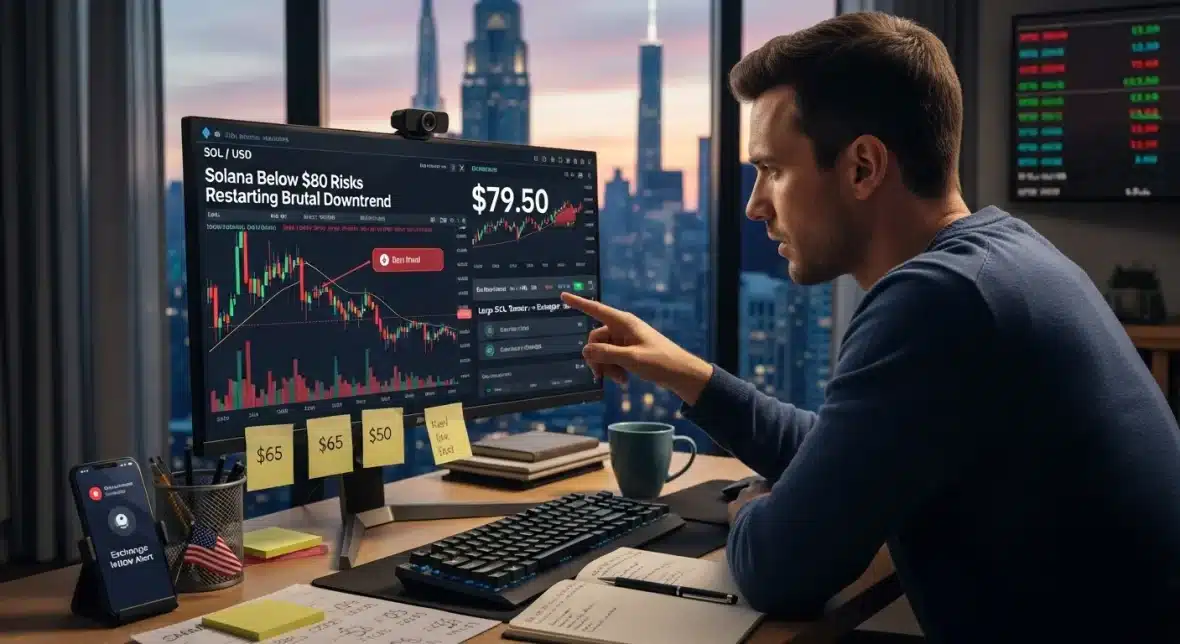
You’re watching Solana (SOL) closely because $80 is acting like a line in the sand. Right now, price action is tense: a break below that area could hand bears control and accelerate losses, while a clean hold might soothe traders and attract fresh buying. In my experience, these moments matter more than headlines, they tell you whether traders are willing to defend positions or throw in the towel. This article gives you a practical, trader‑focused read on where SOL stands, which on‑chain and macro signals matter, and what real, actionable steps you can take if price slips under $80.
Key Takeaways
- Solana (SOL) faces a critical $80 support — a decisive daily close below it with rising volume and exchange inflows likely restarts a fast downtrend toward $65–$50.
- Treat $80 as a sentinel level: monitor daily closes, VWAP rejections, and volume spikes to confirm trendline failure before adjusting exposure.
- Use on‑chain alerts for large SOL transfers to exchanges and falling active‑address metrics as early warning signs to hedge or reduce positions.
- If SOL briefly dips under $80 but reclaims it on strong volume, consider measured long entries with tight stops; if it confirms the break, prioritize cutting exposure or hedging.
- Size positions and set stop losses to match your risk profile, and keep alerts on price, exchange flows, and momentum so you can act quickly rather than react to headlines.
Current Price Context And Recent Price Action

You’ve probably noticed SOL has been flirting with the $80 area after a long stretch of volatility. Over the past several weeks, SOL made a lower high and then tested several support bands: each test has looked progressively weaker. Volume on rallies is muted while sell spikes on down days are sharper, a classic sign sellers have the edge. At the same time, the market’s broader tone hasn’t been supportive: BTC’s recent weakness and risk‑off moves in equities have sucked liquidity out of altcoins, and SOL’s correlation to those assets has tightened.
From a price structure view, SOL’s recent rebounds have failed to reach previous swing highs, and intraday order books show thin bids below the current range. You should treat the $80 zone as a sentinel level, it’s where market participants decide whether to defend long exposure or take quicker losses. I’ve seen altcoin corrections accelerate fast once a key level gives: Solana’s network strength matters, but price follows flows, not fundamentals alone.
Key Technical Levels To Watch
Knowing precise levels helps you avoid guesswork. Below are practical areas to watch in your charting setup and why they matter to your risk decisions.
Support And Resistance Zones
$80 sits near a cluster of prior lows and short‑term psychological support. If that fails, the next meaningful support is around $65–$70, where buyers previously stepped in during the last major pullback. Beneath that, $50–$55 becomes an important structural area, it’s where longer‑term holders are concentrated and where capitulation could occur. On the upside, resistance sits near $95–$105, a zone that has capped rallies recently. A clear break above that would be required to flip market sentiment back toward buyers.
Moving Averages, Trendlines, And Momentum Indicators
On most timeframes the 50‑day moving average has flattened and is close to current price, offering short‑term dynamic resistance. The 200‑day moving average remains above price, which tells you longer‑term trend is still unfavorable. Momentum indicators like RSI are tilted toward neutral‑to‑bearish, not yet deeply oversold, which means there’s room for more downside without an obvious exhaustion signal. Watch trendline integrity on daily charts: a decisive daily close below $80 with rising volume would confirm trendline failure and increase the odds of a swift leg lower.
On‑Chain Signals And Market Structure
On‑chain data gives you raw evidence of behavior beyond price charts. It’s how you know whether holders are nervous, or whether liquidity continues to flow into the network.
Network Activity And Fund Flows
You should monitor active addresses, transaction counts, and total value locked on Solana DeFi protocols. A sustained drop in active addresses accompanied by decreasing deposits into Solana apps means engagement is slipping, that’s not a great backdrop if price weakens. Conversely, rising deposits and expanding TVL can offset price weakness somewhat, as they hint at returning utility demand. Recently, network activity has been steady but not expanding, which leaves price vulnerable to external shocks.
Exchange Flows, Whales, And Large Holder Behavior
Exchange inflows spike before many dumps. If you see growing SOL transfers to exchanges, particularly to centralized exchanges with historically fast execution, treat that as a rising liquidation risk. Monitor on‑chain alerts for large wallet movements: whales shifting from cold storage to exchange wallets often precede heavy selling. In my experience, a few large transfers combined with thin bid liquidity near $80 is the setup that accelerates declines.
Macro And Crypto‑Specific Catalysts That Could Drive A Break Below $80
You don’t trade Solana in isolation. Macro forces and crypto‑specific events can tip the balance quickly, and you should be ready for both.
Macro Risk Factors (Rates, Liquidity, Risk Sentiment)
Rising rates or a sudden tightening of liquidity have a direct effect on risk assets. If central banks push policy tighter than markets expect, or if short‑term funding conditions worsen, you’ll likely see capital flow out of higher‑beta crypto assets first. A spike in risk aversion, like a big equity selloff or credit stress, often drags altcoins down harder than Bitcoin. Keep an eye on real yields and equity volatility as simple, early warning signs.
Crypto‑Native Triggers (Regulation, Security Incidents, Competing Ecosystems)
Regulatory headlines can be swift and market moving. Any new enforcement action or restrictive policy targeting staking services, derivatives, or exchanges can reduce demand for SOL. Security incidents, a major exploit on a Solana app or network instability, would amplify selling pressure immediately. Also, if a competing smart‑contract ecosystem posts significant technology or liquidity wins, you could see capital rotate away from Solana, adding to downside risk. In short: you should monitor both macro feeds and on‑chain incident trackers simultaneously.
Scenario Analysis: What Happens If SOL Drops Below $80
You need clear scenarios so you can act without emotion. I’ll outline three plausible outcomes and what each would mean for your positions.
Bearish Scenario: Rapid Downtrend Restart And Targets
If SOL breaks and closes daily below $80 with rising volume and growing exchange inflows, you should expect a fast move toward $65 and potentially $50 within weeks. Momentum would shift sharply to the downside: short sellers would pile in and stop hunts around lower liquidity pockets could exacerbate moves. In that environment your priority should be cutting exposure or tightly hedging, don’t wait for a “bargain” that may not arrive soon.
Balanced Scenario: Consolidation And Lower‑Volatility Range
SOL could also slip below $80 briefly, find support near $70, and trade in a lower‑volatility range for a few weeks while market participants reassess. This scenario often follows a buy‑the‑dip reaction from longer‑term holders and a pause in selling from whales. If you’re comfortable holding, this environment favors measured accumulation at defined support and using reduced position sizes until conviction returns.
Bullish Rejection Scenario: Failed Break And Quick Reversal Above $80
A false break is possible. Price could dip under $80, trigger stops, then reverse sharply as buyers step in and shorts scramble to cover. If that happens and SOL reclaims $80 with conviction, that’s a bullish sign, it suggests strong demand and trapped sellers provided liquidity for a reversal. For traders, that’s a cue to look for long entries on confirmed rejection candles with volume support, but only with disciplined stops.
Risk Management And Trading Strategies For Investors And Traders
You must protect capital first. That principle trumps chasing gains, especially in a market where a single daily close can change everything.
Position Sizing, Stop Losses, And Timeframes By Risk Profile
Decide what portion of your portfolio you’re willing to risk on SOL and size positions accordingly. If you’re a conservative investor, keep exposure small and use wider timeframes for decisions. For active traders, use tighter stops just below technical supports and size positions so a stop doesn’t threaten your broader portfolio. Set timeframes that match your thesis: swing traders look at daily closes: scalpers watch intraday liquidity and order flow.
Hedging, Diversification, And Use Of Derivatives
Use hedges if you can’t stomach a big down move. Short futures or put options can protect paper losses while letting you retain upside exposure. If you don’t have options access, a simple hedge is to reduce size and allocate into less correlated crypto or stable assets. Diversification matters: keep some capital in high‑quality tokens or cash so you’re not forced to sell into a falling market.
Key Indicators And Alerts To Monitor In Real Time
If you want to act quickly, set up a few alerts and focus on signals that historically precede big moves.
Price, Volume, And VWAP Triggers
Alert on daily close below $80, but also on intraday breaks accompanied by volume above the 30‑day average. VWAP rejections on lower‑timeframe charts can indicate institutional selling: a sustained move below multi‑day VWAP often leads to momentum continuation. Volume spikes on down candles are more meaningful than quiet, slow declines.
On‑Chain Alerts And Exchange Flow Signals
Set alerts for large SOL transfers to exchanges, sudden increases in wallet activity, or big changes in staking behavior. Tools that notify you of whale movements or unusual exchange deposits will give you lead time to act. At Cryptsy, our real‑time flow trackers and exchange netflow widgets are designed to surface exactly these kinds of signals so you can decide quickly.
Where To Watch Next: Important Timeframes And Data Sources
You should combine multiple timeframes and reliable sources to build a clear picture.
Short‑Term (Intraday to Weekly) Vs. Medium‑Term (Monthly) Levels
Short‑term traders focus on intraday order flow, VWAP, and 4‑hour to daily levels like $80 and $70. Medium‑term investors should watch monthly support zones around $50–$55 and the 200‑day moving average. Use shorter frames to fine‑tune entries and longer frames to validate trend direction.
Reliable Data Sources, Charting Tools, And On‑Chain Dashboards
Use reputable charting platforms for price and volume analysis and couple them with on‑chain dashboards that track flows and wallet behavior. At Cryptsy, we aggregate exchange netflows, staking metrics, and real‑time market updates so you can cross‑check price action with fundamental moves. Combine that with chain explorers and major analytics platforms for a rounded view.
Conclusion
If SOL slips below $80, you’re looking at a potentially serious shift in momentum that could restart a rapid downtrend. That doesn’t mean panic, it means having a plan. Watch exchange inflows, volume‑backed daily closes, and on‑chain whale behavior, and match your actions to your risk profile. Protect capital first, then look for disciplined opportunities: failed breaks can offer compelling long setups, but only if you’re strict about stops and sizing. Keep your alerts live, trust the signals over the noise, and let price tell you whether to step back or step in.
Frequently Asked Questions
Why does a close below $80 matter for Solana (SOL)?
A daily close below $80 would signal trendline failure, likely increase selling pressure, and invite faster downside toward $65 and $50. It shows sellers control short‑term flows, especially if accompanied by rising volume and exchange inflows, so traders treat $80 as a sentinel level for risk decisions.
What technical levels should I watch if SOL drops under $80?
Key supports are $65–$70 and $50–$55, with resistance near $95–$105. Monitor the 50‑day MA (short‑term resistance) and the 200‑day MA (longer‑term bearish bias). Volume‑backed daily closes and VWAP rejections signal whether momentum will continue or reverse.
How can I manage risk if Solana (SOL) below $80 restarts a downtrend?
Prioritize position sizing and stop losses: reduce exposure, use tighter stops for active trades, or hedge with short futures/put options. Diversify into less correlated assets and set alerts for daily close below $80, large exchange inflows, and volume spikes to act quickly without emotional decisions.
What on‑chain signals typically precede big SOL selloffs?
Watch exchange inflows, large transfers from cold wallets to exchanges, declining active addresses, and falling TVL or deposits into Solana apps. Spikes in exchange transfers plus thin bids near support often foreshadow accelerated declines as whales and sellers increase liquidation risk.
Can a false break below $80 become a buying opportunity for SOL?
Yes — a false break that reclaims $80 with strong volume can trigger short‑covering and a quick reversal. Look for convincing rejection candles, rising buying volume, and reclaimed VWAP before entering. Maintain disciplined stops and smaller position sizes to manage the risk of another failure.
