
Lucid Stock Price Prediction: Outlook for 2026 and Beyond

As we approach the end of 2025, the conversation surrounding Lucid Group has shifted from pure speculation to a hard look at execution. If you have been following the electric vehicle sector, you know that the last two years tested the resilience of every startup that dared to challenge the legacy automakers. Lucid survived the initial shakeout, but the stock price reflects a market that has grown tired of promises and now demands profitability. The days of valuing EV companies solely on projected growth are over. Investors want to see sustained margins and a clear path to cash flow positivity.
Looking at the charts today, you can see that LCID is trading at a critical juncture. The volatility that defined the stock in previous years has compressed into a tight range, signaling that a major move is imminent as we head into 2026. Whether that move is a breakout to the upside or a capitulation to new lows depends entirely on the company’s ability to scale its new product lines without burning through its remaining capital. This article assesses where Lucid stands right now and what you should expect from the stock price in the coming years.
Key Takeaways
- A reliable lucid stock price prediction for 2026 hinges primarily on the successful market penetration and delivery volume of the Gravity SUV.
- Continued financial backing from Saudi Arabia’s Public Investment Fund prevents insolvency but poses a persistent risk of shareholder dilution.
- Long-term bullish scenarios depend on Lucid transforming into a technology licensor for legacy automakers rather than remaining solely a niche manufacturer.
- Investors must closely watch gross margin progression and production efficiency in early 2026 to identify potential breakout signals from the current trading range.
Analyzing Lucid Group’s Performance in Late 2025
Production Milestones and Delivery Numbers
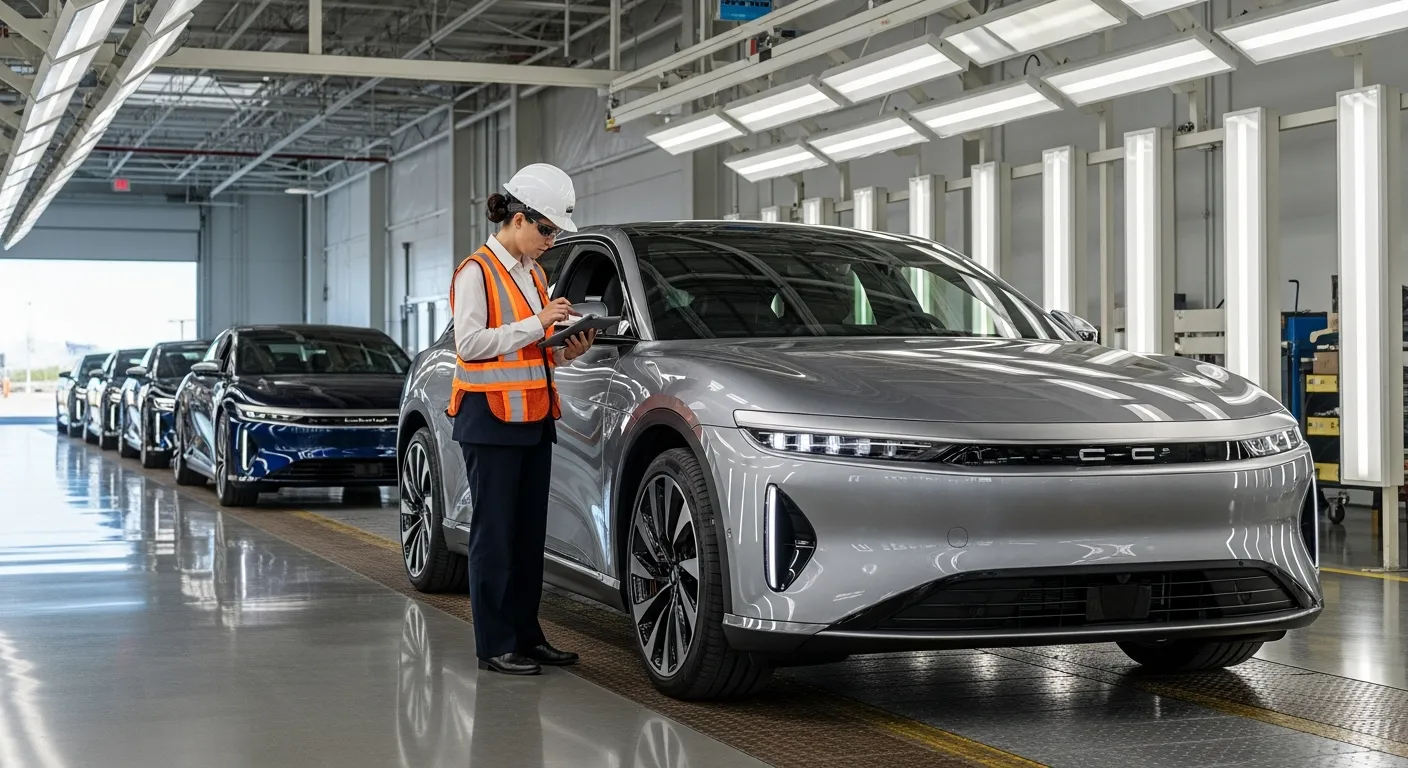
When you look back at the targets Lucid set for 2025, the reality is a mix of impressive engineering and operational friction. Throughout this year, the primary focus was scaling production at the AMP-1 facility in Arizona and the AMP-2 plant in Saudi Arabia. While the company has managed to increase its weekly output, the delivery numbers still lag slightly behind the aggressive estimates analysts put forward earlier in the decade. You have likely noticed that inventory buildup became a concern in the second quarter, forcing the company to use incentives to move the Air sedan. This strategy helped clear the lot, but it naturally pressured margins.
But, the operational story is not all negative. The efficiency of the production line has improved. We are seeing fewer quality control issues reported by new owners compared to the 2023 and 2024 cohorts. This matters because brand reputation in the luxury segment is fragile. If Lucid can prove that it has solved the manufacturing bottlenecks that plagued its early years, the market might begin to price in a higher multiple for its manufacturing capability. The key for you to watch in the final Q4 2025 report is not just the total number of cars produced, but the ratio of cars produced to cars actually delivered to customers.
The Impact of the Gravity SUV Market Penetration
The launch of the Gravity SUV was arguably the most critical event for Lucid in 2025. For years, the company relied on a luxury sedan in a market that overwhelmingly prefers SUVs. Now that the Gravity is in the hands of customers, we are finally seeing whether the demand theory holds water. Early data from late 2025 suggests that the Gravity is cannibalizing some sales from the Air, but more importantly, it is bringing a new demographic into the Lucid ecosystem. These are buyers who need utility but want the range efficiency that only Lucid technology offers.
The market penetration of the Gravity is the single biggest variable for the stock price moving into 2026. If this vehicle fails to capture significant market share from the likes of the Tesla Model X or the high-end electric offerings from Mercedes and BMW, the path forward becomes incredibly narrow. You should pay close attention to the order backlog updates. If the backlog for the Gravity is growing while production ramps, it confirms that Lucid has a demand-side winner. If the backlog shrinks rapidly as deliveries start, it signals that the pool of interested buyers is shallow.
Fundamental Valuation and Financial Health
Revenue Trends vs. Net Losses
You cannot discuss a Lucid stock price prediction without addressing the balance sheet. The revenue trends in 2025 have shown growth, primarily driven by the introduction of the Gravity SUV and entry-level versions of the Air. But, revenue growth means little if the cost of goods sold exceeds the money coming in. Lucid has historically struggled with negative gross margins, meaning it cost them more to build a car than they sold it for. In late 2025, we are finally seeing this gap close, but the company is arguably still operating at a loss on a per-unit basis once you factor in overhead.
Net losses remain the heavy anchor dragging on the share price. While the burn rate has slowed compared to the reckless spending of 2022 and 2023, the company is still consuming cash at a rate that alarms conservative investors. You need to look at the operating expenses line item. Lucid has tried to cut costs by streamlining its workforce and reducing administrative bloat, but R&D costs remain high. To stay competitive in battery tech and autonomous driving, they cannot simply slash the budget to zero. This tension between needing to spend to innovate and needing to save to survive is the fundamental conflict in their valuation.
Liquidity and the Role of the Public Investment Fund
The relationship between Lucid and Saudi Arabia’s Public Investment Fund (PIF) is the most significant factor in the company’s survival. Without the repeated capital injections from the PIF, it is highly likely that Lucid would have faced insolvency by now. For you as a shareholder or potential investor, this is a double-edged sword. On one hand, the PIF acts as an ultimate backstop, virtually guaranteeing that the lights stay on. This lowers the bankruptcy risk significantly compared to other EV startups like Fisker or Lordstown Motors.
On the other hand, this safety net comes at a cost to your equity. Every time Lucid raises capital from the PIF or through public offerings to shore up liquidity, existing shareholders face dilution. In 2025, we saw this play out again as the company strengthened its cash position to support the Gravity ramp. You must understand that while the PIF views Lucid as a long-term strategic asset for their Vision 2030 goals, they are also acquiring more control with every check they write. The valuation floor is essentially set by how much the PIF is willing to pay to keep the project alive.
Technical Analysis and Chart Patterns
Key Support and Resistance Levels
Examining the technicals as of December 2025, LCID stock has spent much of the year establishing a base. After the long downtrend from its post-SPAC highs, the stock found a support zone where value investors stepped in. This level has been tested multiple times throughout the year and has held firm, suggesting that the market believes the worst of the valuation reset is over. If the price breaks below this historical support, it would trigger a wave of stop-loss selling that could push the stock into uncharted territory.
On the upside, there is a heavy layer of resistance that corresponds with the moving averages from earlier in the year. Every time the stock attempts a rally on good news, it hits this ceiling where bag-holders from 2023 and 2024 look to exit their positions at breakeven. You will see this clearly on the weekly charts. For a genuine trend reversal to occur in 2026, the stock needs to break through this resistance on high volume. Without that volume confirmation, any price spike is likely just a short-lived relief rally.
Short Interest and Volatility Indicators
Lucid has consistently maintained high short interest, and late 2025 is no exception. A large portion of the float is sold short by hedge funds betting on further dilution or operational failure. For you, this creates a specific kind of opportunity known as a short squeeze. If Lucid releases a surprisingly positive earnings report or announces a major partnership, the rush of short sellers trying to cover their positions can cause the stock price to explode upward violently. We saw glimpses of this volatility earlier in the year.
But, you should not base your investment thesis solely on a squeeze. The implied volatility on LCID options remains elevated, meaning that the market expects turbulent price action to continue. This makes holding the stock risky for the faint of heart. The technical indicators, such as the Relative Strength Index (RSI), have been oscillating in neutral territory, waiting for a catalyst. The market is effectively in a wait-and-see mode, balancing the short thesis against the potential for a turnaround.
Macroeconomic Factors Affecting the EV Sector
Interest Rates and Capital Costs
The macroeconomic environment in late 2025 is different from the zero-interest-rate era that birthed Lucid, but it is also stabilizing compared to the inflation spikes of the recent past. Interest rates have settled, yet they remain high enough to make borrowing capital expensive. For a company like Lucid that is not yet self-funding, the cost of capital is a direct hit to the bottom line. When debt is expensive, the company is forced to rely more on equity financing, which brings us back to the dilution problem mentioned earlier.
You also have to consider how interest rates affect the consumer. Lucid sells expensive vehicles. Even with the slightly lower price point of the Gravity compared to the Sapphire edition sedans, these are six-figure purchases for many buyers. High auto loan rates dampen demand for luxury vehicles. If rates do not come down significantly in 2026, Lucid faces a headwind where their target demographic might delay purchases or opt for cheaper alternatives. You cannot ignore the correlation between the Federal Reserve’s policy and Lucid’s order book.
Global Supply Chain and Raw Material Prices
Supply chains have largely normalized since the pandemic disruptions, but the geopolitical landscape about critical minerals remains tense. In 2025, we saw fluctuations in lithium and cobalt prices driven by export restrictions and trade policies. Lucid has done a decent job of securing its supply chain, partly due to its backing, but it is not immune to global price shocks. If raw material prices spike again in 2026, Lucid’s path to positive gross margins gets pushed further out.
Besides, the logistics of shipping vehicles from Saudi Arabia to other markets and moving parts globally adds a layer of complexity and cost. You should watch the trade relations between the US and major mineral-producing nations. Any friction there could result in tariffs or supply shortages that would hamper Lucid’s ability to meet its production targets, regardless of how much demand there is for the Gravity.
LCID Price Forecast Scenarios: 2026 to 2030
Bull Case: Profitability and Technology Licensing
In the most optimistic scenario for 2026 through 2030, Lucid stops being just a car company and becomes a technology provider. The deal with Aston Martin was the proof of concept. If Lucid can sign two or three more major legacy automakers to license its powertrain and battery technology, the revenue mix shifts dramatically. Licensing revenue is high-margin. It drops almost straight to the bottom line. In this bull case, the Gravity SUV sells out its production capacity, and the upcoming mid-size platform launches successfully in late 2026 or 2027.
If these things happen, you could see the stock re-rate from a distressed manufacturer multiple to a technology growth multiple. The price could climb significantly as the market realizes the company will not go bankrupt. The narrative would shift to Lucid being the “Intel Inside” of the electric age, providing the most efficient motors to the rest of the industry. In this world, the stock price recovers lost ground and targets the mid-double digits by 2030.
Bear Case: Continued Dilution and Market Saturation
The bear case is darker and, frankly, keeps many investors up at night. If the Gravity launch receives a lukewarm reception and fails to gain traction against the updated Rivian R1S or the Tesla Model X, Lucid will remain a niche player with high overhead. In this scenario, the cash burn continues through 2026 and 2027. The company would be forced to raise billions more in capital, likely from the PIF, heavily diluting public shareholders. The stock price would likely drift lower, potentially falling into penny stock territory or undergoing a reverse split to maintain listing compliance.
Besides, if the mid-size platform is delayed or arrives in a market already saturated by high-quality Chinese EVs and efficient offerings from Toyota and Volkswagen, Lucid might never achieve the volume needed to cover its fixed costs. The ultimate bear scenario is a take-private offer where the PIF buys out the remaining public float at a modest premium to the trading price, effectively capping your potential upside and leaving long-term holders with significant losses.
Conclusion
Lucid Group is entering 2026 with its back against the wall, but it is also armed with the best technology in the sector. The stock price prediction for the next few years is not about lines on a chart but about the execution of a business plan that allows no room for error. You are looking at a binary outcome. Either Lucid successfully scales its volume to match its overhead, transforming into a sustainable luxury brand, or it slowly bleeds equity until it is absorbed entirely by its major backer.
If you choose to invest in LCID at these levels, you are betting on the technology winning out over the financial headwinds. It is a speculative play, not a cornerstone for a retirement portfolio. Keep a close eye on the gross margin progression and the Gravity delivery numbers in the first half of 2026. Those two metrics will tell you everything you need to know about where the stock price is heading next.
Frequently Asked Questions
What is the Lucid stock price prediction for 2026?
Analysts view 2026 as a pivotal year where the LCID stock price depends on the company’s ability to scale the Gravity SUV without excessive cash burn. While the stock has stabilized in a tight range, a breakout relies on improving gross margins and avoiding further dilution; failure to scale could lead to new lows.
Will the Gravity SUV launch help Lucid’s stock recover?
The Gravity SUV is the single biggest variable for Lucid’s recovery. Early data from late 2025 suggests it is attracting a new demographic, but for the stock to appreciate, the order backlog must grow alongside production ramps to prove it can capture market share from rivals like the Tesla Model X.
How does the Saudi PIF investment affect LCID shareholders?
The Public Investment Fund (PIF) acts as a critical backstop that drastically lowers bankruptcy risk compared to other EV startups. However, this safety net is a double-edged sword: continued reliance on PIF capital often leads to equity dilution, which can cap upside potential for existing public shareholders.
Can Lucid stock reach mid-double digits by 2030?
A bullish long-term forecast suggests the stock could target mid-double digits by 2030 if Lucid transitions into a technology provider. By licensing its high-efficiency powertrain and battery tech to legacy automakers—similar to its deal with Aston Martin—the company could secure high-margin revenue streams that re-rate its valuation.
Is Lucid (LCID) a good investment for long-term portfolios?
Lucid is currently considered a speculative investment rather than a cornerstone for retirement portfolios. While it possesses superior EV technology, the company faces significant financial headwinds, including negative margins and high capital costs. Investors are betting on the technology outlasting the cash burn hurdles.
