
Gold Price Prediction 2030: Outlook for Investors
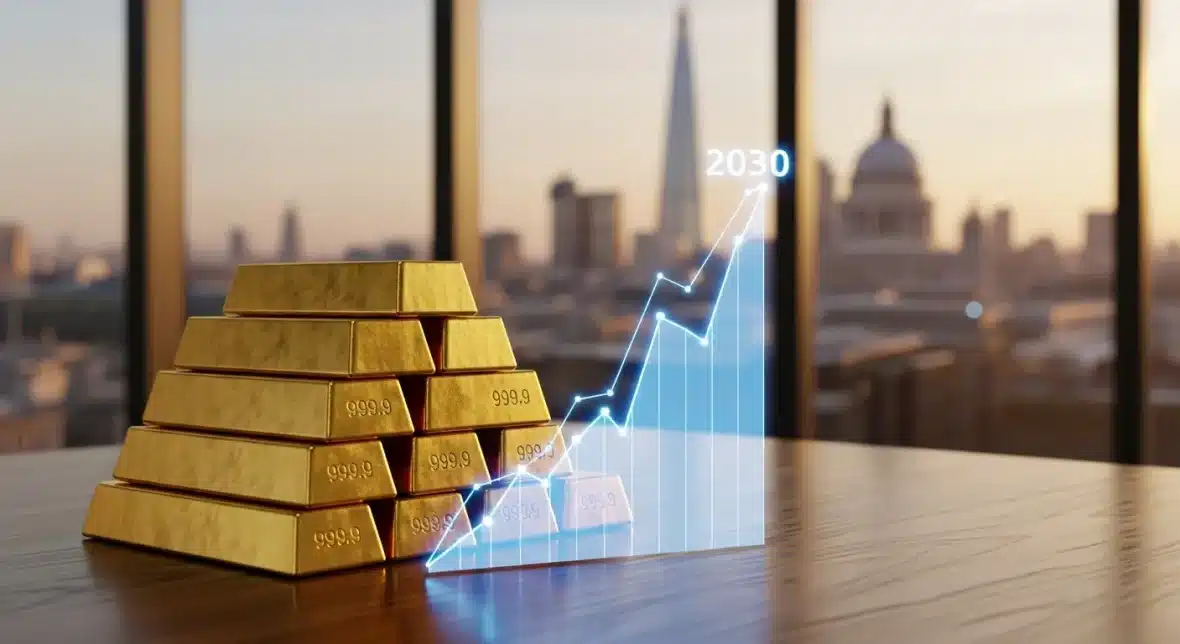
You look at your portfolio today and wonder where safety truly lies. With fiat currencies constantly losing purchasing power and equity markets behaving more volatility than ever, the glittering allure of gold feels less like a luxury and more like a necessity. When we talk about a gold price prediction 2030, we are not just throwing darts at a board. We are analyzing the fundamental shifts in the global economy that suggest a significant repricing of real assets is underway.
In my experience analyzing market cycles, precious metals often sit dormant for years before exploding into a new trading range. You might be asking if we are on the precipice of such a move. The next decade promises to be unlike the last, defined by debt monetization, geopolitical fragmentation, and a scramble for hard assets. This outlook aims to cut through the noise and give you a clear, serious perspective on where gold is likely heading as we approach the 2030 horizon.
Key Takeaways
- Bullish forecasts for the gold price prediction 2030 suggest values could reach $3,000 to $4,000 per ounce due to ongoing debt monetization.
- Central banks in emerging markets are aggressively swapping government bonds for physical gold, effectively creating a price floor for the metal.
- Supply constraints from aging mines combined with rising industrial demand for green tech create a structural deficit that favors price appreciation.
- Gold acts as essential portfolio insurance against geopolitical instability and negative real interest rates expected over the next decade.
- Investors should consider a strategic allocation of 5% to 20% in bullion or mining stocks to protect purchasing power against currency devaluation.
Key Macroeconomic Drivers Influencing Gold Through 2030

To understand where the price is going, you first have to understand the engine driving the car. Gold does not generate cash flow, so its price is almost entirely a reflection of the health, or sickness, of the broader financial system. As we look toward 2030, three specific gears are turning that will dictate the value of every ounce in your safe.
Inflation and Interest Rate Trajectories
The relationship between gold and interest rates is often misunderstood. You might hear pundits say that high rates are bad for gold, but history tells a different story. It is the real interest rate that matters. That is the nominal rate minus inflation. If inflation remains sticky and persistent, which appears likely given the massive global debt loads, central banks cannot raise rates high enough to crush it without bankrupting their own governments. This leads to a period of negative real rates, an environment where gold historically thrives.
By 2030, the sheer cost of servicing sovereign debt suggests that governments will have no choice but to keep interest rates artificially suppressed relative to inflation. This is financial repression in action. When your cash in the bank earns 4% but inflation eats away 6% of its value, you lose money by saving. In that scenario, gold becomes the ultimate savings account. It does not need to yield interest to outperform a currency that is actively dying.
The Role of Central Bank Reserves
One of the most telling signals I have watched recently is the behavior of the world’s biggest money managers: the central banks themselves. After decades of selling gold or holding steady, emerging market central banks are now buying hand over fist. Nations like China, India, Turkey, and Poland are aggressively swapping US Treasury bonds for physical gold bars. They are voting with their wallets.
This trend is essentially a floor price for gold. When price dips occur, these sovereign buyers step in to accumulate more tonnage. By 2030, this shift away from western fiat currencies and toward neutral reserve assets is expected to accelerate. You are seeing a structural change in how the world defines money. If central banks view gold as the only risk-free asset worth holding, it serves as a massive validation for your own private holdings.
Geopolitical Volatility and Safe-Haven Appeal
We have moved past the era of global cooperation and into a fragmented world. Trade wars, kinetic conflicts, and sanctions have weaponized the financial system. In this environment, gold offers something no other asset can: it has no counterparty risk. If you hold physical gold, you do not rely on a bank’s solvency or a government’s promise.
Looking ahead to 2030, geopolitical friction is likely to intensify rather than abate. Whenever fear spikes, capital flees to safety. We saw this during the 2020 crisis and the subsequent conflicts in Europe and the Middle East. Gold acts as portfolio insurance. You don’t buy fire insurance hoping your house burns down, but you sleep better knowing you have it. As global tensions rise, the premium investors are willing to pay for this insurance will naturally increase, pushing the base price of gold higher.
Supply Side Constraints and Industrial Demand
While everyone focuses on who wants to buy gold, few pay enough attention to how hard it is to actually get it out of the ground. The easy gold has already been found. Miners are now forced to dig deeper, in more remote locations, and process lower-grade ore to extract the same amount of metal. This reality is catching up with the industry. I have reviewed countless mining reports, and the trend of declining ore grades is undeniable.
Bringing a new mine online is a nightmare of red tape, environmental permits, and massive capital expenditure. It can take ten to fifteen years from discovery to first pour. This means the supply response to higher prices is incredibly slow. Even if gold hits $3,000 an ounce tomorrow, miners cannot simply flip a switch and flood the market with new supply. This inelasticity on the supply side is a powerful driver for long-term price appreciation.
Besides, gold is not just money: it is a critical industrial metal. As we push toward 2030, the demand for electronics and green energy technologies will consume more gold. It is used in everything from high-end semiconductors to electric vehicles due to its conductivity and resistance to corrosion. Unlike investment gold, which sits in a vault, industrial gold is often consumed and lost. You have a situation where mine supply is struggling to keep up just as a new source of structural demand is emerging.
Price Targets and Expert Forecasts for 2030
Trying to pin down an exact number for a gold price prediction 2030 is difficult, but we can build logical ranges based on the data we have. Analysts generally fall into two camps, and understanding both perspectives helps you manage your expectations.
Bullish Scenarios and Potential All-Time Highs
The bullish case assumes that the trends of debt debasement and geopolitical fracturing continue. In this scenario, many experts see gold effectively doubling from its mid-2020s levels. Prices reaching $3,000 to $4,000 per ounce by 2030 are not out of the question: in fact, they might be conservative if inflation runs hot. Some long-term models that track the expansion of the M2 money supply suggest gold would need to be priced much higher just to catch up with the amount of currency printed since 2008.
If we see a return to a gold-backed trade settlement currency, something the BRICS nations have discussed, the revaluation could be instant and violent. In that specific case, price targets become almost irrelevant as gold would shift from a trading asset to the primary denominator of global value.
Bearish Risks and Downside Factors
You must also consider the other side of the coin. The primary risk to gold is a scenario where global growth explodes, inflation vanishes, and governments somehow manage to balance their budgets. If real interest rates turn significantly positive, meaning you can earn 3% or 4% above inflation in a government bond, institutional money will rotate out of non-yielding assets like gold.
Also, if the US dollar strengthens significantly due to a collapse in other major currencies, gold prices in dollar terms could face headwinds. It might hold value in Euros or Yen, but the dollar price could stagnate. But, given the current fiscal path of the US, a decade of massive dollar strength seems the less likely path, but it is a risk you should acknowledge.
Strategic Portfolio Allocation for the Coming Decade
So, what do you do with this information? Knowing the price might go up is different from knowing how to position your portfolio. The standard advice of a 60/40 stock-bond split has failed investors recently because stocks and bonds fell together. Gold creates true diversification.
For the conservative investor, an allocation of 5% to 10% in gold acts as a ballast. It stabilizes the ship when the waters get rough. If you are more aggressive and agree with the bullish thesis about currency debasement, you might push that allocation to 15% or 20%. I have found that owning physical bullion offers the best peace of mind, but high-quality mining stocks can offer leverage to the gold price if you have the stomach for volatility.
The key is consistency. Do not try to time the exact bottom. You are better off accumulating a position slowly over time. Dollar-cost averaging into gold takes the emotion out of the trade. You are building a position for 2030, not for next week’s trading session. View your gold holdings as the part of your portfolio that you hope you never strictly need, but will be incredibly grateful to have if the financial system stumbles.
Conclusion
The road to 2030 is paved with uncertainty. While we cannot say for certain that gold will hit a specific number, the fundamental drivers, excessive debt, geopolitical instability, and central bank accumulation, all point in one direction. The wind is at gold’s back. By holding gold, you are effectively shorting the idea that politicians will fix the economy without printing money. That has historically been a very winning bet. As you look at your own wealth, consider gold not just as a trade, but as a long-term guardian of your purchasing power.
Frequently Asked Questions About Gold Investment
What is the realistic gold price prediction 2030 based on current trends?
Market analysts forecast that gold could reach between $3,000 and $4,000 per ounce by the end of the decade. This gold price prediction 2030 is driven by structural economic shifts, including debt monetization, persistent inflation, and a lack of new mining supply to meet rising demand.
How do real interest rates affect the future value of gold?
Gold historically thrives in environments with negative real interest rates (where inflation exceeds nominal interest rates). As governments likely suppress rates to service massive debt loads through 2030, cash savings will lose purchasing power, positioning gold as a superior wealth preservation tool compared to fiat currency.
Will cryptocurrency replace gold as a safe-haven asset by 2030?
While crypto acts as a digital alternative, it is unlikely to replace physical gold as a primary safe haven. Central banks favor gold for its lack of counterparty risk and millennia-long track record. Most experts view the gold price prediction 2030 as independent of crypto, with gold remaining the ultimate stabilizer during geopolitical volatility.
Why is the global supply of gold struggling to keep up with demand?
The mining industry faces a structural deficit due to declining ore grades and a lack of new discoveries. Bringing a new mine online can take 10–15 years due to regulatory hurdles. This supply inelasticity means miners cannot quickly increase production, which supports higher prices even as industrial and investment demand grows.
Is it better to invest in physical gold or gold ETFs?
Owning physical bullion offers the best protection against systemic financial failure since it carries no counterparty risk. However, ETFs provide higher liquidity and are easier to trade for short-term profit. For a long-term gold price prediction 2030 strategy, holding physical metal is often recommended for true portfolio insurance.
